
Section Styles alternate-P3
THREE:
Moves
No. 1 | Spring 2026

Issue One
Moves
Issue One Moves
Table of Contents
by Vera Jerinic-Brodeur
01
02
by Jenevieve Hutchison
03
by Christie Tate
Editor’s Note
Welcome to the first issue of THREE! It is such an honor to bring these pieces to you, tied together by the quarterly theme of “moves.” As I read through submissions, an unexpected sub-theme emerged: pace. Often, we think about movement as action, forward momentum, arrival. But how often do we recognize the power in the subtlety of pace? Probably about as often as we favor the feminine side over the masculine of any concept.
When we negotiate with pace, we are making choices: Do we acquiesce or push back? Who sets the pace of our lives? When do we shift, and how? For the writers in this issue, the answers vary. They reveal what happens when shifting health and aging bodies alter our tempo and how it feels to find freedom of movement when the world has forced upon you a rhythm that is not yours.
These three pieces weave together defiance, uncertainty, and acceptance: a Black woman reclaiming the narrative and choreography she carries in her body, a runner making peace with an inevitable finish line, and a daughter faced with the reality that she is now stronger than her aging father. They measure pace in shuffled steps, miles traveled, basslines that cannot be contained. With every modulation comes a revision of identity.
Sometimes our paces shift out of necessity and resignation, and sometimes from a deliberate move into alignment with ourselves. To move is one thing; to move differently than we used to is another. Whether our adapted rhythm happens by our own will or against it, we are left asking, “Who am I now?” This issue of THREE illuminates the disorientation and clarity that comes with a change of pace. I hope you love these pieces as much as I do.
XO, Steph
Finish Chute: A Eulogy
by Vera Jerinic-Brodeur
They found me when life was at its darkest. At war with my body and in constant battle with my mind, desperation almost took hold. Into that emptiness they strode without a walking break, offering not solutions but identity.
Together we covered many miles, short sprints to long slow distances. We navigated courses filled with change and varying tempos, breathless intervals of high intensity and pauses for my regressing spirit to rest. At times, I pushed them away. You’re not important. I don’t need you anymore, I whispered. You take me away from where I should be grounded. But they simply stayed.
Through existential despair, or a short fuse with my husband, or impatience with my small children, we were better together. Despite the days of slogging self-doubt, they helped me find moments of elation, accomplishment, and power that were mine alone. To give me the credibility I craved, they demanded I keep moving forward.
From the Northeast to the West Coast to the desert, each time my family moved, we built community from groups of women who also found themselves in miles. Our lives were diverse, but we were the same over long and short distances, climbs and descents, various types of terrain. They had a way of making the ordinary feel sacred. Every fueling cup of coffee, every short-of-breath conversation, every post-race bagel became a lace in the tapestry of comradery that defined much of a lifetime. In their presence, I felt whole, like the version of myself I strode to be—strong, capable, special.
Then I pursued a second chance career, training and coaching others who’d also believed they could never go that far. Together we lifted them up, dusted them off, and led by example. How would I get anywhere without them?
After more than three decades of a mostly steadfast kinship, they’ve taken their leave as my moving force. I am inexplicably stiff and sore, short of breath and of reasons to continue. My pace has plummeted. Is it menopause, aging, deconditioning? Have I simply lost my edge? Perhaps our relationship has finally run its course.
Yet I’m riddled with ambivalence. Torn like a compromised ligament, understanding the time has come to move on, while refusing to let go of what has given me meaning and made me worthy of admiration for so long. I’d hoped to evolve beyond my all-or nothing mindset, but I think I’d rather hang up my Brooks than continue to half-ass it.
I’ve said this before. Tattooing 26.2 on my left foot (the one with the pinky toenail I lost in Portland, and attached to the ankle I’ve sprained so many times) felt like an exercise in finality. But back then it seemed I could do just one more, and then another.
How do we know when it’s the end? When we enter the finish chute? Is it simply when we choose to never forget? If this is truly the end, I’ll gather the boxes of race shirts that have moved thousands of miles, now nestled in the depths of my basement. I’ll make a quilt of their remnants, a talisman crafted with gratitude and the fabric of my soles. The years of sisterhood, guidance, and direction will never be forgotten. Dear friend, thank you for being my compass, and for propelling me from the shadows feet first into the light.
Author’s Note: A finish chute is a narrow passageway used in races to guide athletes safely to the finish line, When I first wrote this piece, I’d been experiencing a long, steady decline in my fitness. Initially, I gaslit myself, reasoning that I’d become lazy and let myself fall out of shape. Then I went through menopause and determined I was struggling to run even a few miles because of this physiological change and overall aging. After further plummeting in all physical ability, I decided to seriously pursue the cause. After months of testing and doctor’s appointments I was diagnosed with a heart condition and will have a pacemaker implanted in the coming weeks. My cardiologist assures me I will be able to run marathons again, if I so choose. While I’m relieved to have answers and a “solution,” I’m left wondering how I’ll decide whether or not to continue. Just because I can, doesn’t mean I should. Am I clinging to a former version of self like a petulant child? How do any of us know when we’ve entered the finish chute? When we’ve reclaimed our identity regardless of the shoes we’re wearing? Even then, maybe there are more miles to cover. Perhaps this is not the end.
Section Styles author-bio
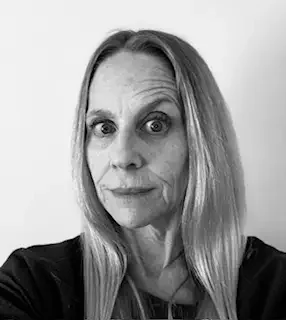
Vera Jerinic-Brodeur is a born-again writer and mostly retired fitness professional. She currently publishes a column, Everyday Strength, on Substack and recently started a cottage bakery with the intention of building a granola empire in midlife. Vera is the mother of two adult children and lives in Upstate New York with her husband and their two rescue dogs.
Freestyle
Freestyle
Freestyle Freestyle
Freestyle
by Jenevieve Hutchison
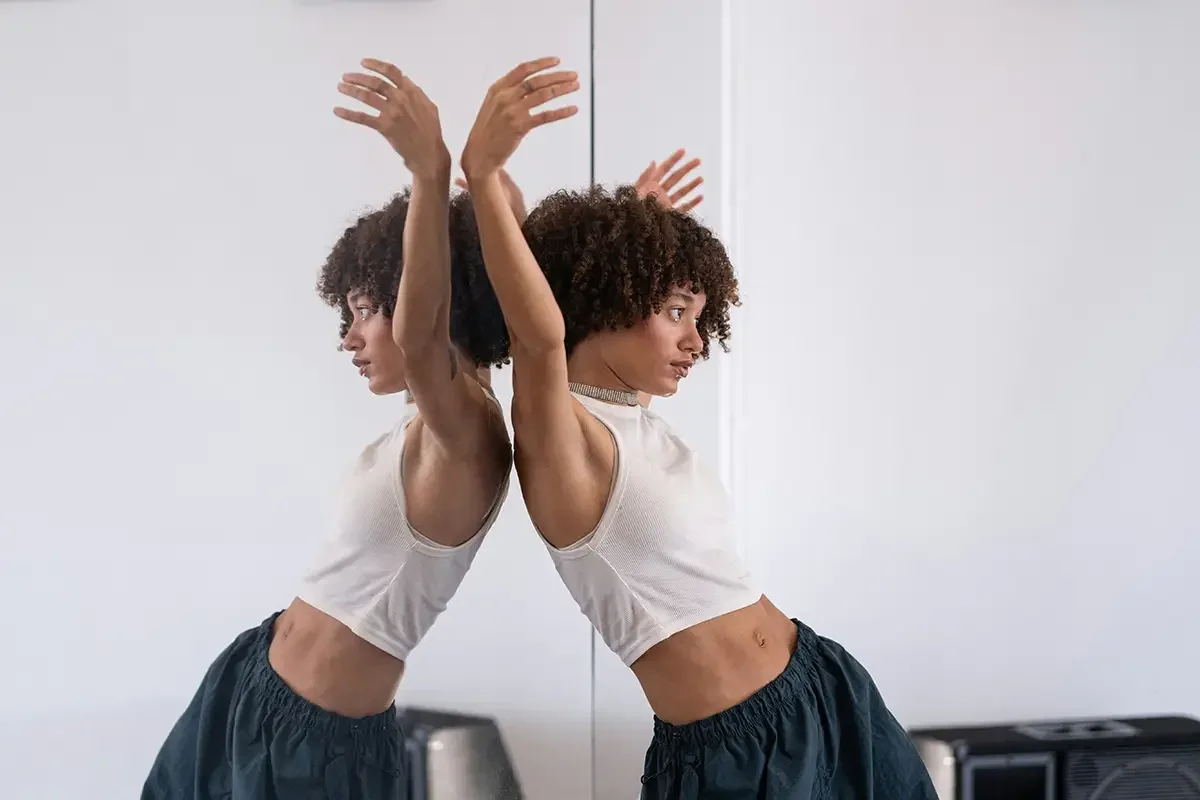
Before the first note hits, my mind is loud.
Lists and worries, memories playing on loop.
My breath is thin, caught high in my chest.
I stand at the edge of the floor,
knees locked, jaw tight,
waiting for a reason to soften.
I walk in on beat, anti-matter.
Don’t I matter?
The bass taps my ribs like a friend at the door,
Come outside.
I close my eyes as my chest answers with a small inhale,
You can’t turn me away.
A nod only my lungs can see.
Shoulders melt.
Knees unlock.
The room starts stretching.
I am standing, and I am already leaving,
hoping the music reaches deeper than whatever tried to stay stuck in me today.
Sound arrives like a slow wave.
My fingers twitch first, tiny circles, testing the current.
I’m not performing yet; I’m listening.
Exhales lengthen.
Heart falls into step.
Awareness narrows.
My head a steady nod on the downbeat,
just enough to say,
I hear you.
When my spine loosens, and my neck stops trying to be long
and simply is,
each vertebra is given permission, one by one,
to stop holding the day up all by itself.
Then the track shifts,
and a memory presses in—
when dance did not feel like this.
When studios were lined with mirrors
and I could see everything except myself.
My feet were obedient,
heels kissing in first position,
knees bending on count,
and I stayed tucked into something smaller,
where my body was allowed,
but my fullness was not.
I learned pliés and pirouettes,
but they never learned how to pronounce my name.
The music changed when the tap shoes came out
and jazz hands shook with fingers splayed,
and again when the hip-hop bass dropped
and something rose up inside me.
A language I recognized
in my bones.
Now my hips catch the bassline,
left-right-left,
a conversation between me and a drum
I’ve never met but somehow know.
The track thickens.
Wrists loosen, ankles wake.
Time tilts.
I start traveling.
I am still learning new ways to be
a Black person,
a Black woman,
a Black mother,
in a world that keeps trying
to choreograph my existence
when memory lives in the fascia,
in micro-tremors of muscle,
in tiny hesitations and sudden surges.
Movement stops just being dance
and becomes archive.
Honor.
My ancestors moved through chains,
through cotton fields and juke joints,
through church pews and migration,
segregation and doors slammed in their faces.
Their bodies absorbed whips and weather,
hunger and side-eyes.
But also: rhythm.
Alchemy.
Turning pain into pattern,
fear into footwork,
exhaustion into a two-step that said,
We are tired, but we are not done.
That holy possession
starts as a swell in my chest.
My torso rocks,
ribs tracing crescent moons
no one can see but me.
My waist follows,
drawing slow figure eights.
The bassline tells my spine
where to curve.
I’m not counting anymore,
just answering the call
of claps and stomps
and babies rocked to sleep
with coded directions to freedom.
My solo is never solo.
It is a chorus of mothers and daughters,
men whose hands split from work
and still found a way
to slide into a shuffle on the way to bed.
Their resistance lives
in my refusal to hold back here.
Over-expressive.
Unapologetic.
A reminder to every room that borrows our rhythm
but will never know our blues
that our memory isn’t an option.
The track builds toward its peak,
and my legs feel heavy and light at once.
Quads burning.
Lungs working.
My heart isn’t panicking,
but rejoicing.
That inner narrator that critiques every move
has gone quiet,
or maybe it’s just out of breath
trying to keep up
as new routes carve themselves,
from sound to breath,
breath to muscle,
muscle to release—
release not because I solved anything,
but because I let something honest
travel through places that had only known tension.
The world keeps trying to dictate
how we move—when, where, how much—
but I am moving, and I am being moved.
When the last note fades,
I’m breathing harder,
sweating a little,
smiling a lot.
I don’t land where I started.
But I stand,
chest heaving,
feet buzzing,
heart loud in my ears.
The day’s problems—
emails, headlines, microaggressions I sidestepped—
replaced by pulse, dust, one shared flesh.
Free/style—it’s how my body finishes
what my mind cannot.
Section Styles author-bio
Jenevieve “J” Hutchison works at a media agency in Carlsbad, California. This is her first published work.

Walking Home
by Christie Tate
I spot my parents as I pull up to the curb, hoping the airport cops don’t yell at me. Mom wheels her suitcase over, helps me hoist it into the car, and then whispers in my ear, “Can you help your dad?”
When I peek around the trunk, I see him taking small steps, not really picking up his feet. Shuffling, really. His smile beams from below his giant gray cowboy hat as he calls out my name, but I can tell from the pinch of his eyes, he’s hurting.
The cop waves her flag, urging us along. I feel a spark of rage. Can’t she see we’re moving as fast as we can?
“What’s up with your feet?” I ask Dad as he buckles his seatbelt. My tone blends concern and nonchalance.
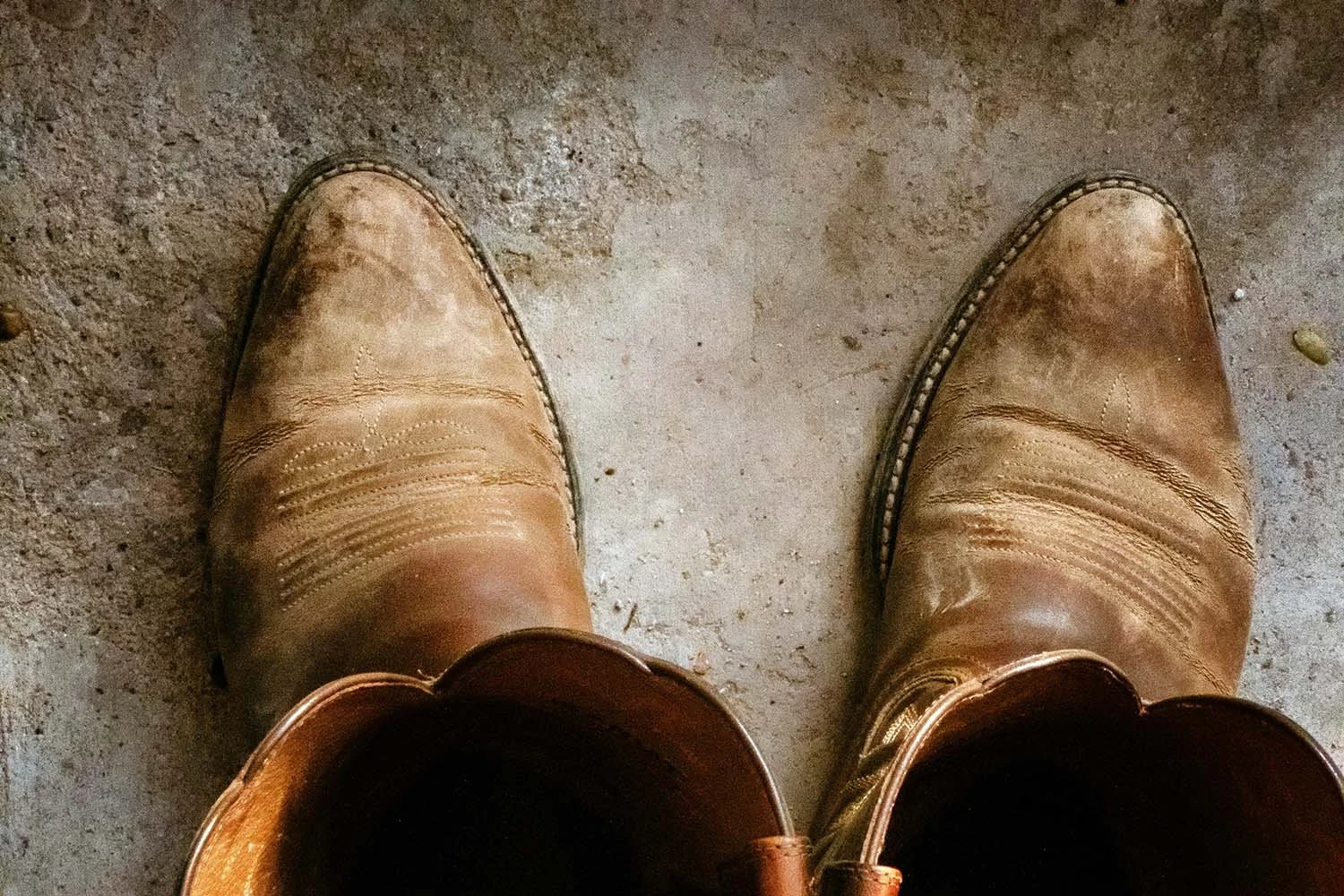
“Nerve pain. I shouldn’t have worn my boots.” He loves his cowboy boots—shiny caramel-colored Lucchese. Calf leather that he shines every Sunday night. If this proud Texan man—my dad—rolled up in New Balance tennis shoes, I wouldn’t recognize him. He’s never not worn his boots to the airport. The thought of it contracts my heart to make room for a sob.
Should I suggest a wheelchair or one of those carts that carries folks with mobility issues from the security line to the gate? That’s not what he wants to hear, and it’s not what I want to say. I don’t want to be here, at this stage—the let’s-get-you-more-help era. Not yet.
Highway traffic is light, and the late-fall Chicago sun sinks below the tree line. I fill them in on how my kids are doing; Mom shares some harmless church gossip.
As I steer the car toward the sidewalk in front of the bakery, I say, “Ya’ll get in line. I’ll join you in a sec.”
Mom steps out of the car and wraps her long black coat around her. Dad tells her to order him an iced tea.
“Aren’t you coming?” she asks him.
Dad shakes his head. “I’m going to walk with her,” he gestures at me. “It’s nearly dark.”
“I’ll be fine. Go with Mom.” My alarms are blaring, but he won’t get out. Not until I do.
He shuts the door and smiles at me.
Trouble walking? This is news. At 81, he hasn’t been truly spry in a few years, but he’s been fully capable of walking. His main issues have been sinus-related. Half the time I call him, he’s getting over a sinus infection, or starting medication for one, or sure that one’s brewing. He recently signed up with a concierge doctor to help him manage his near-chronic symptoms after opting against surgery at his age.
“I’ll get your bag.” I reach for his suitcase.
“Careful, it’s heavy,” he says, guiding it with his hands but not really lifting it.
“I’ve been working out.” It’s true. At my gynecologist’s suggestion, I started a weight-training regimen after I turned 50. I’ve enjoyed the ease of hefting groceries to the kitchen or putting my luggage in an overhead bin, but it doesn’t feel like a victory to have more muscle than my dad.
To ease my alarm, I ask about doctors, diagnoses, and treatment as we drive. He points out the window at the long line at the drive-thru Starbucks, and then the Mexican restaurant on Cicero that went belly up last month, and then the high price of gas at the BP.. I want to know how long he’s been suffering; he wants to tell me about the man who does their lawn in Dallas who’s getting a divorce. I take the hint.
“Hungry?” I ask.
“Starving,” they both answer.
The new bakery in my neighborhood is the perfect spot for an afternoon snack. Yes, the pastries are flaky and light, but even better: I know I can pull close to the entrance, let them out, and then park the car. No extra steps for Dad in those boots.
There’s no sense in fighting. I park the car as close as I can—about 20 yards away. As we walk, Dad grabs my arm; I put my hand over his. I think of what I heard Ram Dass say: We’re all just walking each other home. I slow my pace so my steps match Dad’s. Left, right, left, right. We shuffle toward the warm light of the bakery where Mom waits for us in a booth by the window.
Section Styles author-bio
Christie Tate is an author and essayist. Her memoir, Group, was a NYT bestseller and has been translated into 19 languages. She lives in Chicago with her husband and two children.